

21 Oct
AI AND STRATEGIC LEADERSHIP
Introduction
It is important for university students and student leaders to understand and engage with AI because it is increasingly shaping how people learn, work, communicate and make decisions. Knowing how to use it thoughtfully can help students make the most of its benefits while recognising its limits and risks.
- Builds practical capability: AI can support research, brainstorming, data analysis, communication and productivity. Students who learn to use these tools can apply them more effectively in study, work and community projects.
- Strengthens critical judgment: AI can produce inaccurate, biased or incomplete answers. Understanding how it works helps students question its outputs, verify information and decide when human expertise is needed.
- Supports responsible leadership: Student leaders may encounter AI in decisions affecting their peers—such as communications, services, events or student support. They need to consider privacy, fairness, transparency and who might be left out.
- Creates new ways to reach people: AI-enabled tools can help leaders tailor communications, improve accessibility, gather feedback and connect with wider or more diverse groups. These uses should still respect consent and protect personal information.
- Helps students influence the future: Students are not only future employees; they are citizens, innovators and leaders. Their perspectives can help shape how universities and society adopt AI, including whose needs it serves and what safeguards are necessary.
The goal is not to use AI for everything, but to combine its capabilities with human qualities—judgment, empathy, creativity, accountability and collaboration. Student leaders who do that can use AI to serve people better, rather than simply adopting technology because it is available.
The Target Audience and Format
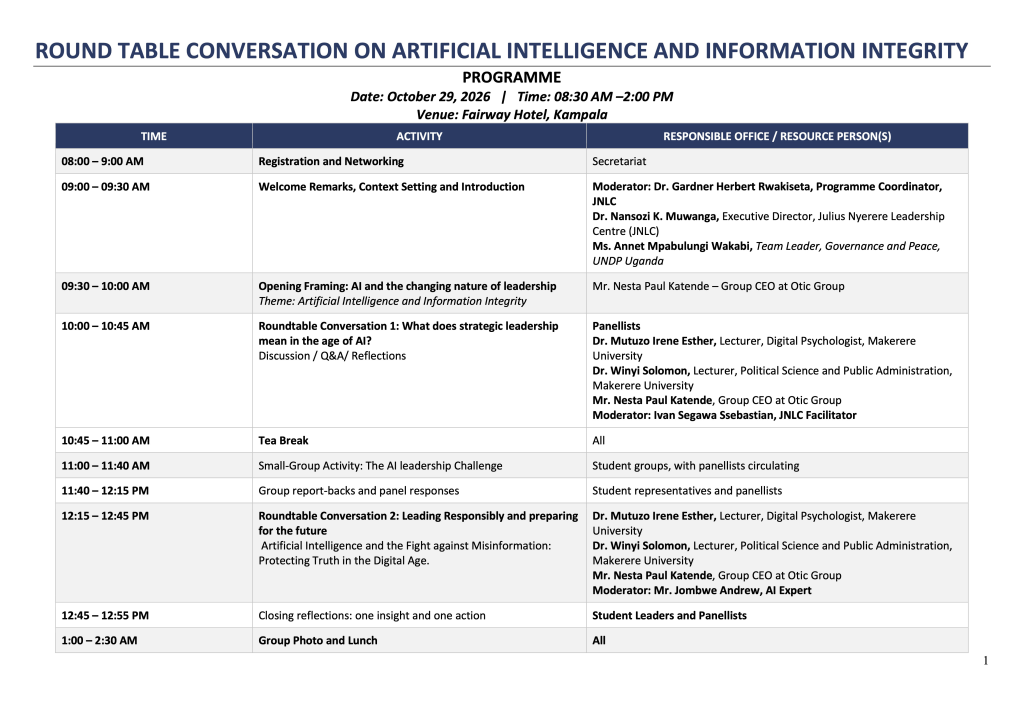
The target audience for the half day AI programme is 40 university students who are also alumni of the JNLC Leadership training. The Roundtable engagement will consist of moderated roundtable with 4 panelists, plus student participation. In addition, there will be break out groups to have more in-depth discussion of specific themes.
Suggested Discussion Themes
The moderator is to invite each panelist to offer a brief opening perspective, then guide a shared conversation around:
- How is AI changing strategic decision-making and the skills leaders need?
- Where should leaders rely on AI, and where should human judgment remain central?
- How can organisations address bias, privacy, transparency and accountability?
- How might AI affect jobs, education and opportunity for the next generation?
- What should students do now to prepare to lead in an AI-enabled world?
Small-group Activity: The AI Leadership Challenge
Each group will be given a short scenario, such as a university considering an AI tool for student support or assessment. Ask them to agree on:
- The opportunity AI could create.
- The main risks or people who could be affected.
- What information or safeguards leaders would need before acting.
- Their recommendation to the university leadership team.
Groups will share a concise recommendation. Panelists can respond with practical considerations and questions rather than evaluating the groups’ answers.
Moderator’s Role
The moderator should balance contributions across all four panelists, connect their perspectives, invite students into the discussion, and keep the conversation accessible. To encourage participation, collect questions on cards or digitally as well as taking questions from the floor.