
06 Nov
The Office of the 92nd Guild Speaker of Makerere University, in partnership with the East Africa Young Leaders Forum, the Netherlands Institute for Multiparty Democracy (NIMD), the Julius Nyerere Leadership Centre (JNLC) and the Parliament of Uganda, hosted the University Students Leaders Convention 2026 on Friday.
Held at the Conference Hall of the Parliament of Uganda, the convention took place under the theme “The Role of University Student Leadership in Advancing National Development, Social Cohesion, Peace and Unity in Uganda.” It brought together student leaders from universities and other institutions of higher learning across the country for engaging discussions on leadership, governance and youth participation. The event was graced by the 12th Speaker of the Parliament of the Republic of Uganda, Jacob Marksons Oboth, alongside several distinguished Members of Parliament. Student leaders from 65 universities and institutions of higher learning attended, together with 10 secondary school coordinators.


The Executive Director of the Julius Nyerere Leadership Centre (JNLC), Dr. Nansozi K. Muwanga, delivering her opening remarks at the University Students Leaders Convention 2026.
In her opening remarks, the Executive Director of JNLC, Dr. Nansozi K. Muwanga, told the participants that the positions they hold today have meaning only in so far as they are able to advance the interests of Uganda. “So, I encourage you to see your time in this space as student leaders, not only as an important preparation, but also as a responsibility for what lies ahead,” she said.
In his keynote address, Speaker of the Parliament of the Republic of Uganda, Jacob Marksons Oboth reminded the participants that President Yoweri Museveni, Hon. Karuhanga and many others once sat where the student leaders now sit. He told them that what they do in those positions determines where they go next, stressing that “student leadership is a process, not a product.” He urged the leaders to remain focused despite the hardships they may face. Drawing from his own story, he emphasised that they do not need a godfather to get where they want to be, only God in their lives.


The Speaker of Parliament of the Republic of Uganda, Jacob Marksons Oboth, delivering his keynote address at the University Students Leaders Convention 2026 at the Parliament of Uganda Conference Hall.
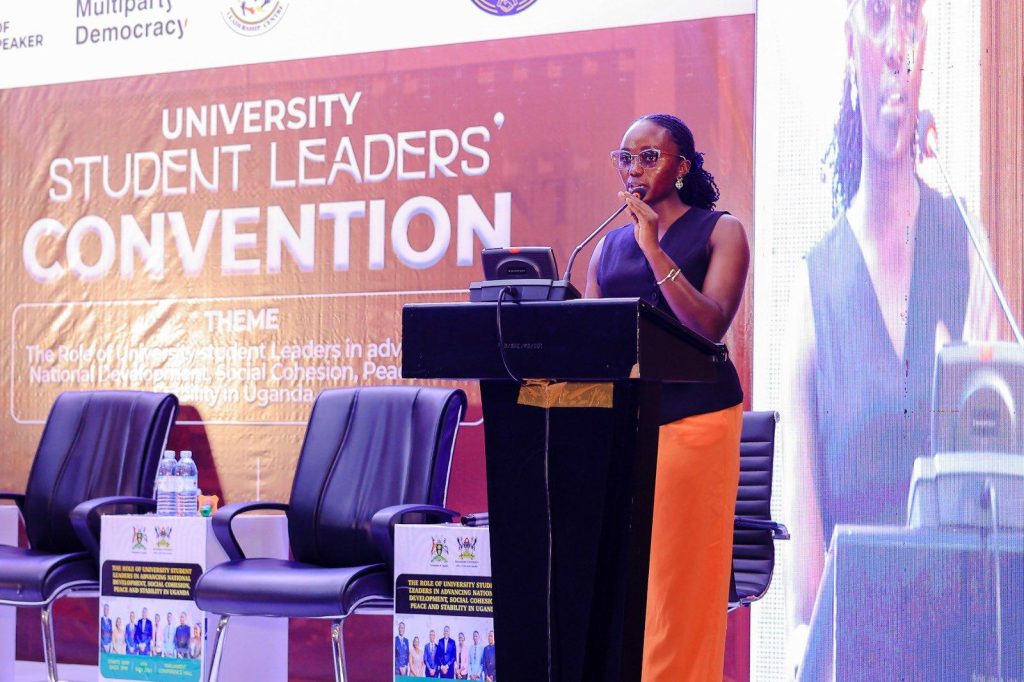
JNLC alumna and National General Secretary of the NRM Youth League, Ms. Natasha Ahereza, delivering a keynote address on behalf of the East Africa Young Leaders Forum at the convention.
JNLC alumna and National General Secretary of the NRM Youth League, Ms. Natasha Ahereza, delivered a keynote address on behalf of the East Africa Young Leaders Forum. She emphasised that young leaders can shape Uganda today, not just lead it tomorrow, through service, innovation, honest leadership, accountability and respectful dialogue.
The convention also featured a panel discussion on “The Economy & Young People,” under the theme “Expanding Youth Employment & Economic Opportunity Through Entrepreneurship, Skills Development and Meaningful Participation in Economic Decision-Making.”
Moderated by Mr. Phillip Murisa, the discussion brought together a diverse panel of youth leaders. They were Hon. Begira Sam, Central Youth Member of Parliament, Mr. Abias Bakashaba, Secretary for Labour Affairs at the National Youth Council, Ms. Natasha Ahereza, Secretary General of the NRM Youth League and Mr. Otim Thomas, Guild President of Soroti University.
The panellists shared insights on the challenges and opportunities facing young people in today’s economy. They highlighted the importance of entrepreneurship, skills development, innovation and access to meaningful employment opportunities.
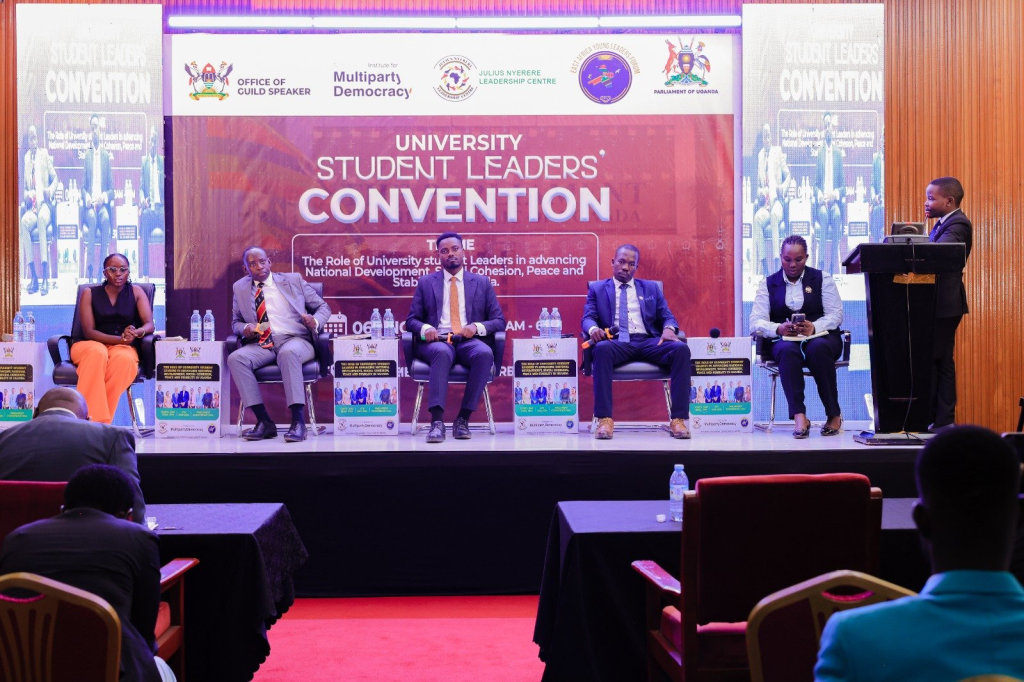
Panellists and the moderator, Mr. Phillip Murisa, during the discussion on “The Economy & Young People” at the University Students Leaders Convention 2026.
They also stressed the need for greater youth representation in economic decision-making, noting that young people must not only be beneficiaries of development but active participants in shaping the economic policies that affect their future.